
What Makes Great Sky Different From Typical Solar Companies
What Makes Great Sky Different From Typical Solar Companies
What Makes Great Sky Different From Typical Solar Companies
Last updated:
Last updated:
0
0
min read
min read
What Makes Great Sky Different From Typical Solar Companies
Last updated:
0
min read
Introduction
If you’ve looked into solar at any point in the last few years, there’s a good chance the experience left a bad taste.
Maybe it was the door-to-door rep who had a polished answer for every hesitation. Maybe it was a proposal full of numbers that didn’t quite add up, or a quote that seemed surprisingly low compared to everyone else. Maybe you said no and still got three follow-up calls.
You’re not imagining it. The solar industry has a sales problem — and most companies operating in it are built around that problem, not despite it.
Great Sky Solar is not like most companies. That’s not a marketing claim. It’s a structural one. The difference between how we work and how most solar installers operate isn’t about attitude or mission statements. It comes down to how the company is built, who does the work, and what those people are actually incentivized to do.
The Subcontractor Problem Nobody Talks About
More than 95 percent of solar installers don’t employ the crews that install your system.
They use subcontractors — independent teams hired on a per-job basis, paid by the watt or by the array size. That payment structure creates one incentive: finish fast and move on. A subcontractor’s income depends on volume. The faster they work, the more they earn. There is no financial reason to slow down and do something correctly when doing it quickly pays more.
This doesn’t mean every subcontracted installation fails. It means the system isn’t designed to reward quality — it’s designed to reward speed. And in an industry where most companies expect to operate for three to four years before folding or being absorbed, there’s rarely anyone left to answer for the outcome anyway.
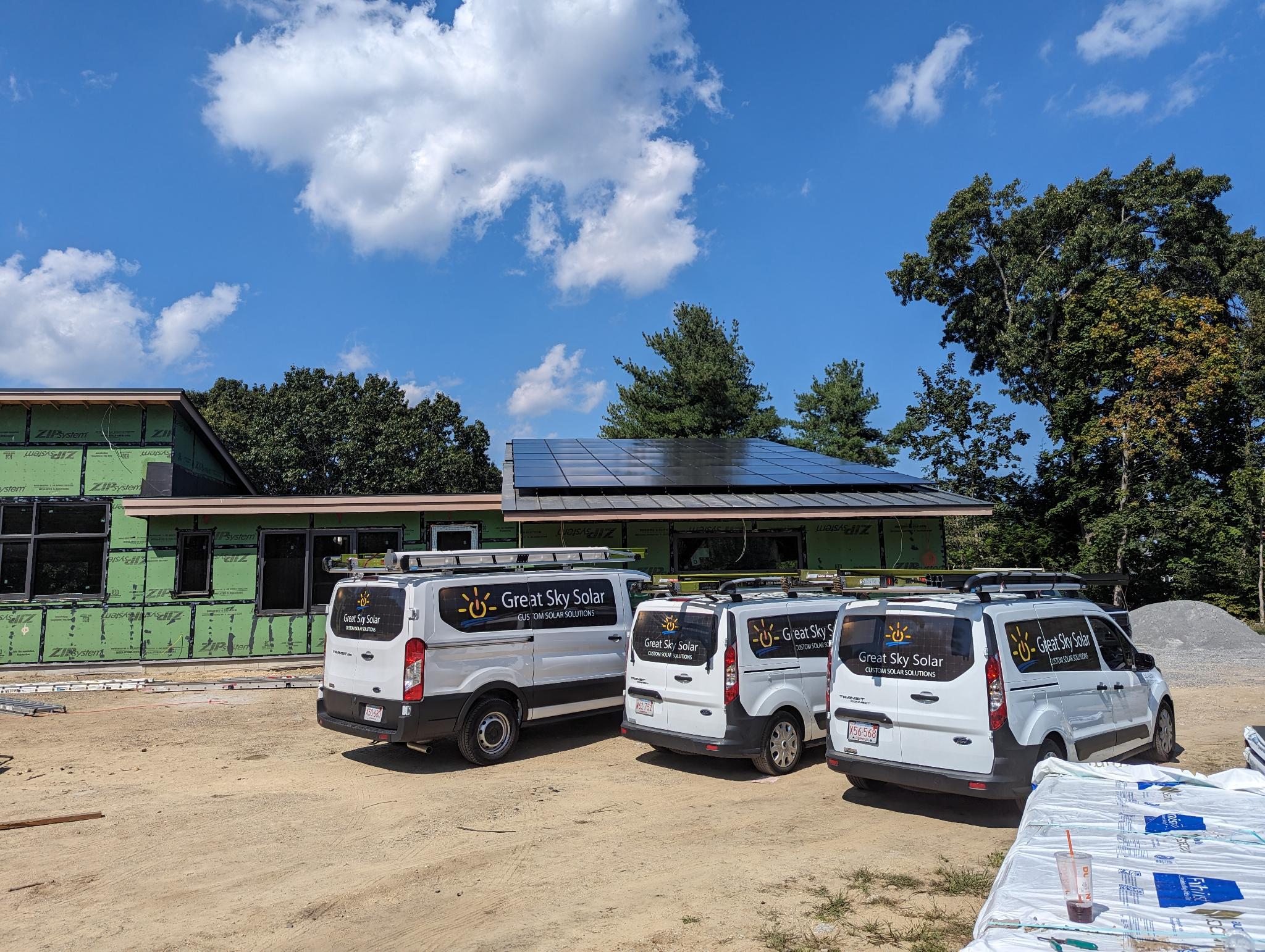
Great Sky has never used a subcontractor. Every person who touches your system — from the initial site assessment through the day it’s turned on — is a full-time, salaried employee of Great Sky Solar. Not paid by the watt. Not racing to finish just to get to the next job. Their only job is to do the work right, every time.
What Salaried Actually Means for You
The distinction between volume-based pay and a flat salary matters more than it might seem on the surface.
When someone's income depends on how many jobs they complete, what's good for them and what's good for you stop being the same thing. They need to move fast. You need a system that performs correctly for the next two or three decades.
A salaried employee’s only performance metric is the quality of their work. If they cut corners, they hear about it. If they do it consistently, they don’t stay. That’s a different relationship between a worker and their work — and it produces a different result for the homeowner standing under the roof.
It also means Great Sky can make a commitment most solar companies can’t. If something goes wrong with your system, the same team that installed it is still here. There’s no subcontractor to chase down. No third party to negotiate with. We own every part of the job from contract to completion.
The Numbers Game
Here’s something most homeowners don’t realize until it’s too late: the price difference between solar quotes is often not what it looks like.
A lot of companies will tell you your home needs 20 solar panels to generate 10,000 kilowatt-hours per year and quote you $25,000. A company that models your roof carefully will tell you it actually takes 28 panels to hit that same target — and their quote comes in at $32,000.
The first number looks better. But it’s built on a production estimate designed to make the price attractive, not to reflect what your roof will actually generate. When your system produces less power than projected, the savings you were promised don’t materialize. You’ve been sold a financial instrument based on numbers that were never meant to be accurate.
Great Sky models every home with precision that most companies skip because it makes their quotes look less competitive on paper. That means accounting for your specific roof orientation, shading, seasonal exposure, and local weather patterns. It’s a more detailed process. It produces a more honest number. And it produces a system that actually delivers on its promises.
The question to ask any solar company isn’t how much it costs. It’s how you arrive at that production estimate. The answer tells you almost everything you need to know about the company you’re dealing with.
Two Months. Sixty-Five Hours. One Point of Contact.
Getting solar installed is not like hiring someone to paint a room. Between the day you sign an agreement and the day your system powers on, there are permits to pull, inspections to pass, utility applications to file, and approvals to obtain from the town, the state, and your electricity provider.
Done properly, this process takes roughly two months. Every Great Sky customer is assigned a dedicated project manager who handles it all — an average of 65 hours of administrative work per customer. That’s not an estimate. It’s what the work actually requires.
Your project manager knows your job. They’re tracking it. When something slows down — and something always does — they’re the ones following up. You’re not navigating a phone tree or waiting on a form. You have one person who owns the outcome from our side.
Most solar companies treat this part of the process as overhead. We treat it as the job.
Built for the Long Run
The solar industry is going through real disruption right now. Incentive structures have changed, financing is evolving, and companies that were built around a single tax credit are under significant pressure. In periods like this, the difference between a company built for volume and one built for longevity becomes very apparent, very quickly.
Great Sky Solar has been operating since 2012. The people who started this company are still here. The employees who installed systems five years ago are still here. That continuity isn’t accidental — it’s the result of building a business that earns its reputation through the quality of the work rather than the strength of its marketing.
We’re not interested in being the largest solar company in Massachusetts. We’re interested in being the most accountable one.
Is Great Sky the Right Fit for You?
We’ll be direct: Great Sky Solar is not the right choice for every homeowner.
If your roof has significant shading, solar may not make financial sense no matter who installs it. If the numbers don’t produce a genuine return on your investment, we’ll tell you that — even if it means not getting the job. Our interest is in an outcome that’s genuinely good for you, not a sale that looks good on a spreadsheet.
If solar does make sense for your home, the difference in who installs it will matter for a long time. An installation done correctly by a team that’s still around to back it up is a fundamentally different outcome than the alternative.
The best way to know where you stand is to have an honest conversation. No pressure. No pitch. Just a straightforward look at your home, your energy situation, and whether solar makes sense for you.
Introduction
If you’ve looked into solar at any point in the last few years, there’s a good chance the experience left a bad taste.
Maybe it was the door-to-door rep who had a polished answer for every hesitation. Maybe it was a proposal full of numbers that didn’t quite add up, or a quote that seemed surprisingly low compared to everyone else. Maybe you said no and still got three follow-up calls.
You’re not imagining it. The solar industry has a sales problem — and most companies operating in it are built around that problem, not despite it.
Great Sky Solar is not like most companies. That’s not a marketing claim. It’s a structural one. The difference between how we work and how most solar installers operate isn’t about attitude or mission statements. It comes down to how the company is built, who does the work, and what those people are actually incentivized to do.
The Subcontractor Problem Nobody Talks About
More than 95 percent of solar installers don’t employ the crews that install your system.
They use subcontractors — independent teams hired on a per-job basis, paid by the watt or by the array size. That payment structure creates one incentive: finish fast and move on. A subcontractor’s income depends on volume. The faster they work, the more they earn. There is no financial reason to slow down and do something correctly when doing it quickly pays more.
This doesn’t mean every subcontracted installation fails. It means the system isn’t designed to reward quality — it’s designed to reward speed. And in an industry where most companies expect to operate for three to four years before folding or being absorbed, there’s rarely anyone left to answer for the outcome anyway.
Great Sky has never used a subcontractor. Every person who touches your system — from the initial site assessment through the day it’s turned on — is a full-time, salaried employee of Great Sky Solar. Not paid by the watt. Not racing to finish just to get to the next job. Their only job is to do the work right, every time.
What Salaried Actually Means for You
The distinction between volume-based pay and a flat salary matters more than it might seem on the surface.
When someone's income depends on how many jobs they complete, what's good for them and what's good for you stop being the same thing. They need to move fast. You need a system that performs correctly for the next two or three decades.
A salaried employee’s only performance metric is the quality of their work. If they cut corners, they hear about it. If they do it consistently, they don’t stay. That’s a different relationship between a worker and their work — and it produces a different result for the homeowner standing under the roof.
It also means Great Sky can make a commitment most solar companies can’t. If something goes wrong with your system, the same team that installed it is still here. There’s no subcontractor to chase down. No third party to negotiate with. We own every part of the job from contract to completion.
The Numbers Game
Here’s something most homeowners don’t realize until it’s too late: the price difference between solar quotes is often not what it looks like.
A lot of companies will tell you your home needs 20 solar panels to generate 10,000 kilowatt-hours per year and quote you $25,000. A company that models your roof carefully will tell you it actually takes 28 panels to hit that same target — and their quote comes in at $32,000.
The first number looks better. But it’s built on a production estimate designed to make the price attractive, not to reflect what your roof will actually generate. When your system produces less power than projected, the savings you were promised don’t materialize. You’ve been sold a financial instrument based on numbers that were never meant to be accurate.
Great Sky models every home with precision that most companies skip because it makes their quotes look less competitive on paper. That means accounting for your specific roof orientation, shading, seasonal exposure, and local weather patterns. It’s a more detailed process. It produces a more honest number. And it produces a system that actually delivers on its promises.
The question to ask any solar company isn’t how much it costs. It’s how you arrive at that production estimate. The answer tells you almost everything you need to know about the company you’re dealing with.
Two Months. Sixty-Five Hours. One Point of Contact.
Getting solar installed is not like hiring someone to paint a room. Between the day you sign an agreement and the day your system powers on, there are permits to pull, inspections to pass, utility applications to file, and approvals to obtain from the town, the state, and your electricity provider.
Done properly, this process takes roughly two months. Every Great Sky customer is assigned a dedicated project manager who handles it all — an average of 65 hours of administrative work per customer. That’s not an estimate. It’s what the work actually requires.
Your project manager knows your job. They’re tracking it. When something slows down — and something always does — they’re the ones following up. You’re not navigating a phone tree or waiting on a form. You have one person who owns the outcome from our side.
Most solar companies treat this part of the process as overhead. We treat it as the job.
Built for the Long Run
The solar industry is going through real disruption right now. Incentive structures have changed, financing is evolving, and companies that were built around a single tax credit are under significant pressure. In periods like this, the difference between a company built for volume and one built for longevity becomes very apparent, very quickly.
Great Sky Solar has been operating since 2012. The people who started this company are still here. The employees who installed systems five years ago are still here. That continuity isn’t accidental — it’s the result of building a business that earns its reputation through the quality of the work rather than the strength of its marketing.
We’re not interested in being the largest solar company in Massachusetts. We’re interested in being the most accountable one.
Is Great Sky the Right Fit for You?
We’ll be direct: Great Sky Solar is not the right choice for every homeowner.
If your roof has significant shading, solar may not make financial sense no matter who installs it. If the numbers don’t produce a genuine return on your investment, we’ll tell you that — even if it means not getting the job. Our interest is in an outcome that’s genuinely good for you, not a sale that looks good on a spreadsheet.
If solar does make sense for your home, the difference in who installs it will matter for a long time. An installation done correctly by a team that’s still around to back it up is a fundamentally different outcome than the alternative.
The best way to know where you stand is to have an honest conversation. No pressure. No pitch. Just a straightforward look at your home, your energy situation, and whether solar makes sense for you.
Share this post


Smarter Energy Starts Here.
Powered by the Sun | © Great Sky Solar | All Rights Reserved
Smarter Energy Starts Here.
Powered by the Sun | © Great Sky Solar | All Rights Reserved
Smarter Energy Starts Here.
Powered by the Sun | © Great Sky Solar | All Rights Reserved